Most founders treat branding as something to fix eventually. At Seed, that instinct is defensible. You are still figuring out what the product actually is, who the real customer is, and whether the core thesis holds. Everything is temporary. The deck changes, the positioning changes, the name might change. Spending serious money on a brand identity at that stage is often the wrong call.
Series A is different.
By the time you raise, you have proven something. The value proposition is real. The users exist. Investors have bet real money on your story. What you build next in terms of brand, product presentation, and visual identity needs to last longer than the next pivot. It needs to work for the customers you are acquiring, the hires you are competing for, and the follow-on investors who will scrutinize every touchpoint.
According to Q1 2026 funding data, median valuations for AI startups at Series A now sit around $51.9 million. At that level of scrutiny, a brand that looks like it was assembled over a weekend is not a cosmetic problem. It is a signal problem.
What changes at Series A that makes branding a different decision:
The stakes are higher. Investors, enterprise buyers, and top-tier hires all evaluate your brand before they evaluate your pitch. Inconsistency reads as operational immaturity.
The brief is clearer. You know what you change for your users. A good studio can now distill that into something durable, not just something that looks polished.
The system needs to scale. Whatever gets built now will be extended by your team, your agency partners, and your marketing hires for the next two to three years.
This list ranks studios by fit for that specific moment, not by reputation or Dribbble following. Full disclosure: Heartbeat, the studio behind this article, is included in the list. It sits where it does because the criteria we used to evaluate everyone else apply equally to us.
What Investors Actually Notice in a Startup Brand
Founders often think investors look past the brand and focus on the numbers. Some do. Most do not, at least not entirely.
According to a survey by First Round Capital, 68% of investors say presentation quality influences their perception of a startup's professionalism and attention to detail. That is not a soft signal. That is the majority of the people you are pitching forming an impression before you get to your unit economics slide.
"Investors feel when a brand was made from a template. It does not matter that the colors are different or the font is new. The structure is the same. The thinking is the same. And they have seen it fifty times already." -- Dima Lepokhin, co-founder, Heartbeat
The numbers support the instinct. Research cited by Brightscout suggests startups with strong, cohesive brand identities are 2.5x more likely to receive funding and achieve valuations roughly 23% higher than comparable companies with weaker visual presentation. Treat those figures as directional, not precise, but the direction is consistent with what most experienced founders already feel.
Three things investors actually notice:
Overall consistency. Does the deck match the site? Does the site match the product? Does the product match the pitch? Inconsistency across touchpoints signals that the team does not yet have a shared vision of what the company is.
Design intelligence. Is the visual system doing real work? Does it reinforce the company's positioning, product logic, and narrative? Or is it decoration layered on top of a story that has not been resolved?
Uniqueness. Templated branding reads as low-conviction. If your brand looks like it could belong to three other companies in the same category, it probably will not stick.
A strong brand does not just look good. It reduces cognitive friction. It makes the company easier to understand, easier to remember, and easier to advocate for internally when the partner goes back to pitch their colleagues.
How I Evaluated the Best Design Agencies for Series A Startups
Most agency listicles do not explain how they picked the list. This list uses five criteria that come directly from what Series A founders actually need, not what agencies want to be known for.
The five criteria:
Stage-specific experience (beyond 0-to-1). Can the studio untangle an already messy brand? At Series A, most companies have some design history. The right studio knows how to audit what exists, keep what works, and rebuild what does not.
Portfolio range. If every project in a studio's portfolio looks aesthetically identical, that is a red flag. The best studios have visually diverse portfolios where you can feel each client's distinct identity.
Traceable, real work. Can you find the clients? Do they exist, raise money, and operate publicly? Beautiful case studies with anonymized clients are not proof of anything.
Startup tempo and flexibility. Series A companies move fast and change focus. The studio needs to handle multiple iterations and shifting priorities without losing momentum.
Right-sized team. Large agencies can add layers. Solo operators are a single-point-of-failure risk. The sweet spot is a small but formed senior team.
Criterion | What to look for | Red flag |
|---|
Stage experience | Work with post-traction companies | Only 0-to-1 portfolio |
Portfolio range | Visually diverse projects | Every client looks the same |
Traceable work | Real, findable clients | Anonymous or unverifiable cases |
Startup tempo | Iteration-friendly process | Rigid phases, slow feedback loops |
Team size | 4-20, senior-led | Large agency layers or solo risk |
What Does It Cost to Hire a Design Agency After Series A?
Budget ranges for design work vary wildly depending on who you ask and what they are selling. Here is a grounded picture based on current market data and what studios in this category actually charge.
According to Splash Creative's 2026 benchmark data, funded startups typically spend between $12,000 and $75,000+ on design services, with Series A identity work specifically clustering in the $15,000 to $40,000 range. Focused engagements with a clear scope can turn around in two to four weeks. Broader projects covering brand, product, website, and design systems take longer and cost more.
Scope | Typical budget range | Typical timeline |
|---|
Brand identity foundation only | $15,000 - $40,000 | 2-4 weeks |
Identity + website | $30,000 - $60,000 | 4-8 weeks |
Identity + product design | $40,000 - $70,000 | 6-10 weeks |
Full scope: identity, product, site, marketing, design system | $60,000 - $100,000+ | 8-16 weeks |
Before comparing price tags across studios, get clarity on who actually does the work, what is included in the scope, and how revisions and pivots are handled.
1. Ramotion
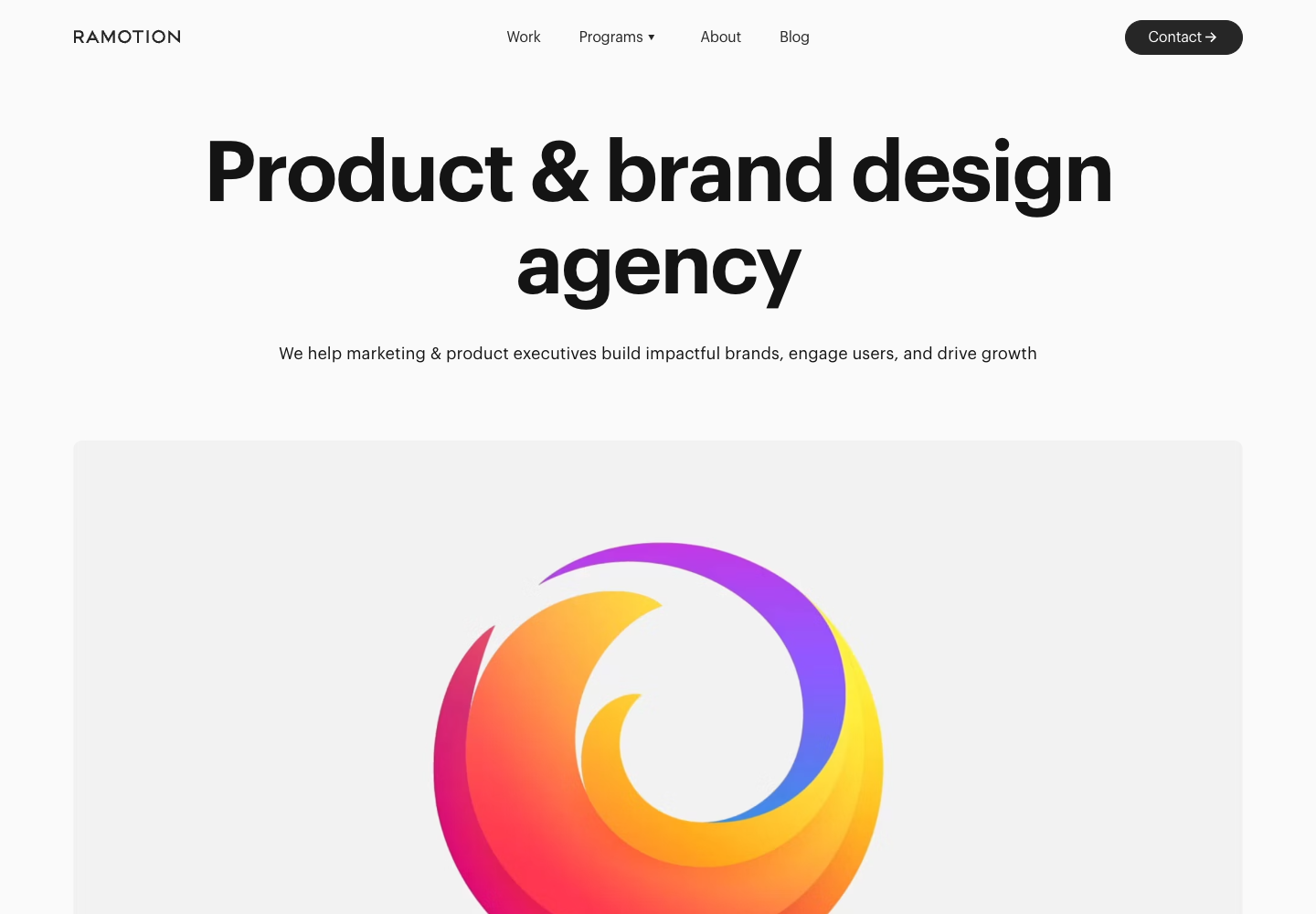
Best for: Product-led SaaS and tech startups that already know their positioning and need a highly competent partner to express it consistently across brand and UI.
Ramotion has built a strong reputation in tech-centric branding, specifically at the intersection of brand identity and product UX. Their work is tight, contemporary, and closely tied to how the product actually functions. If your startup's brand needs to feel like an extension of the interface rather than a separate layer on top of it, Ramotion is worth a close look.
Their client history includes companies like Mozilla, Salesforce, Stripe, and Pipedrive, according to third-party editorial coverage. The work is traceable and the clients are real.
Where Ramotion fits best:
Product-first teams where the UI and the brand need to feel unified
SaaS companies with a clear positioning already defined, needing execution
Founders who value polished, contemporary digital aesthetics over narrative-heavy brand strategy
Teams that want a studio with demonstrated experience working at scale
Where to apply diligence: Product polish and narrative distillation are different skills. Ramotion excels at the former. If your core challenge is that you have not yet resolved what your company stands for, a studio with stronger strategic distillation capabilities may serve you better at this stage.
2. Heartbeat
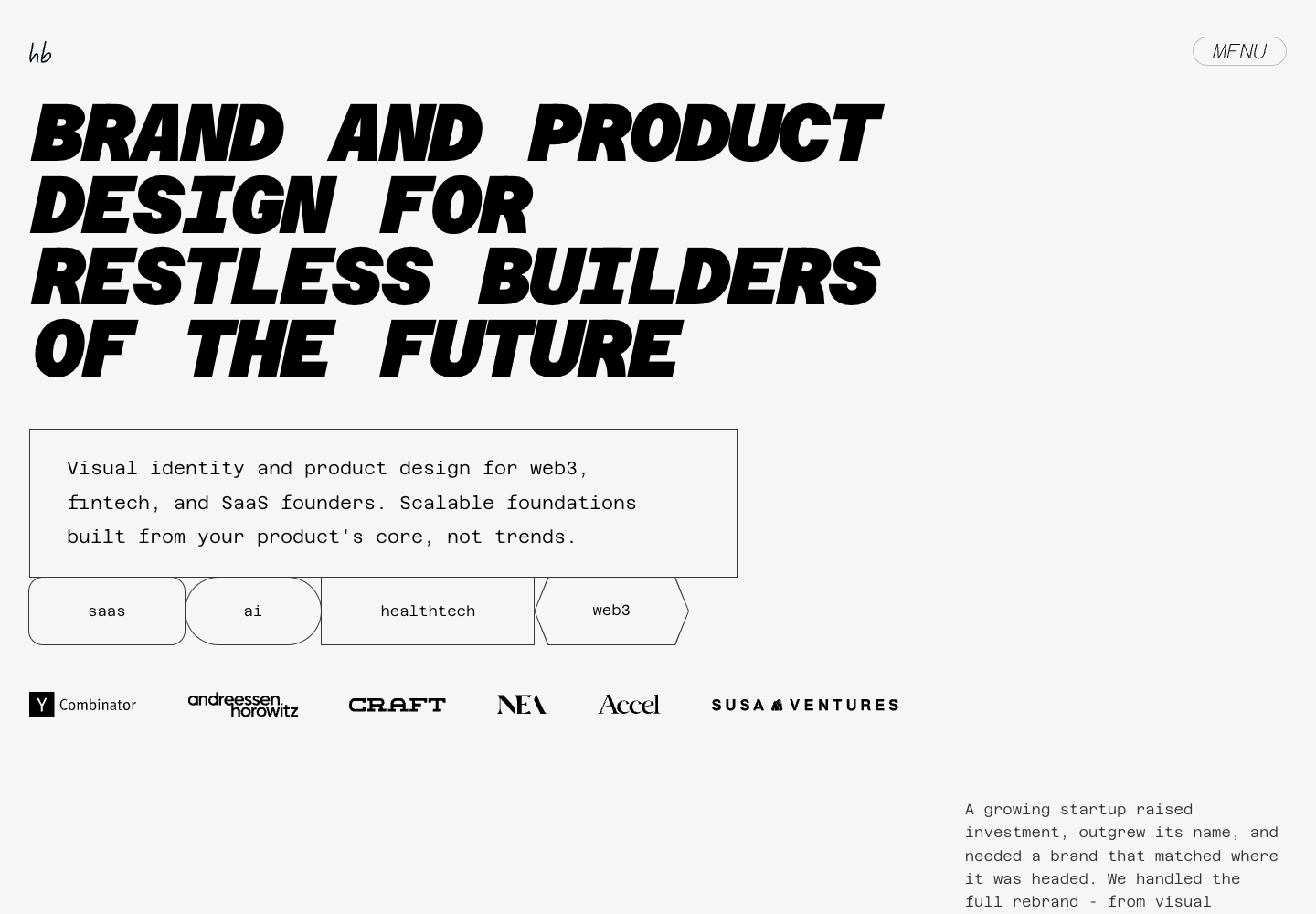
Best for: Series A founders who have traction, some design debt, and a product that needs a clearer narrative translated into a scalable identity system across brand, product, and site.
Heartbeat is a seven-person senior design studio based in Barcelona and Odesa. Every person on the team is a senior. The people on the discovery call are the people doing the work. There are no account managers, no junior designers interpreting a brief, and no outsourcing. That operating model matters when you are paying for nuance and speed at the same time.
The process starts with understanding the current state: what exists, what is working, and what is creating friction. From there, the work is about distillation. What does this product actually change for its users? What is the core value that the brand needs to carry? Once that is clear, the visual language gets built around it and scaled into a system the team can extend without Heartbeat in the room.
What this looks like in practice:
Discovery and audit of existing brand and product touchpoints
Distillation of core value proposition into a visual and verbal identity logic
Identity system built for scale, not just for launch
Delivery of a foundation the internal team can actually use
Best for:
Founders approaching or just past Series A with a real product and a brand that has not kept up
Teams that have tried to fix design internally and hit the ceiling of what non-designers can resolve
Startups that need brand, product, and site to feel like one system, not three separate projects
Watch out for: Heartbeat is not the right fit if you need a full development team or if you want a massive agency with dedicated account management layers. The studio is intentionally small. Clients who have worked with Heartbeat have collectively raised over $1 billion in funding. Budget range is $40,000 to $100,000 depending on scope.
3. Focus Lab
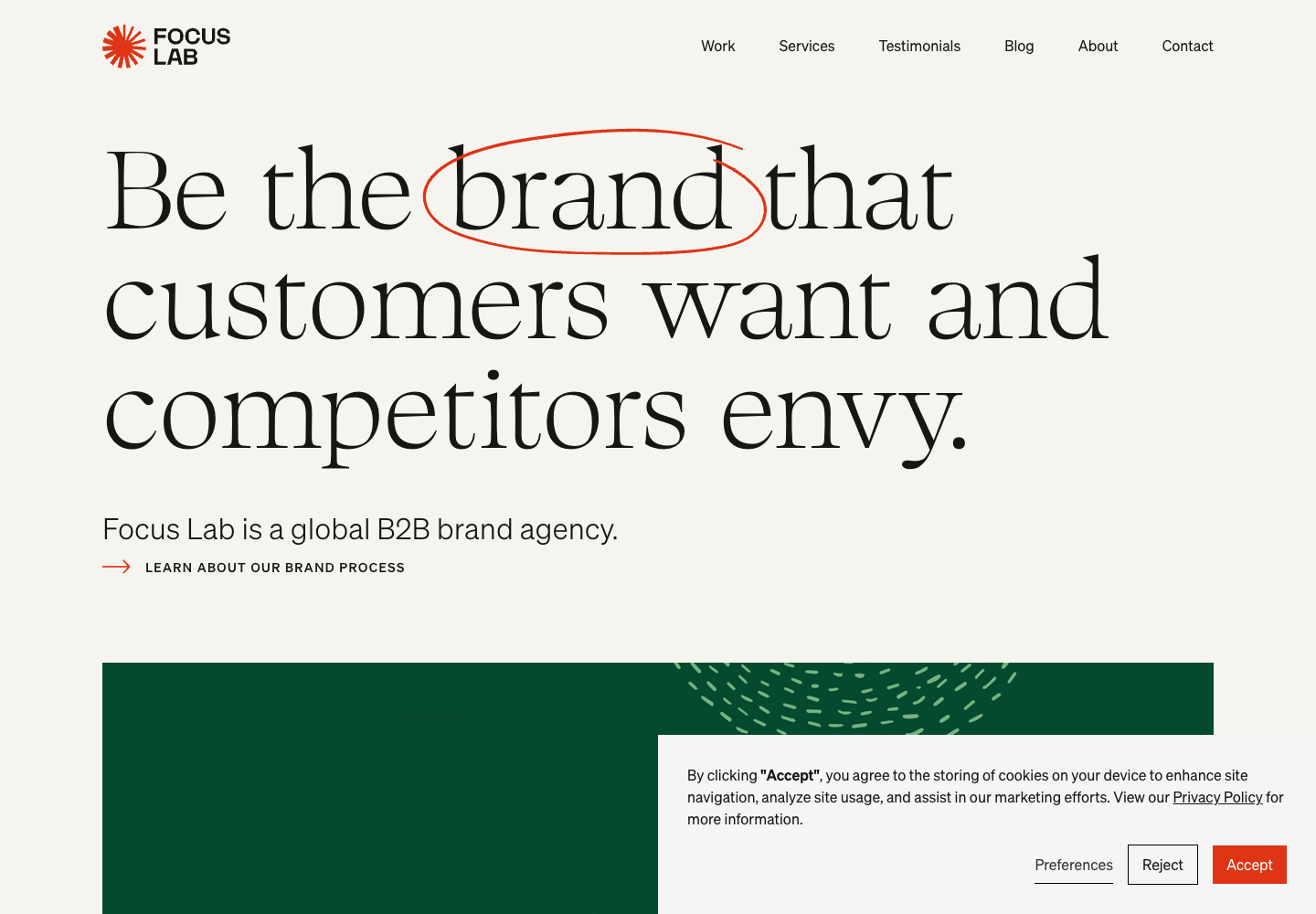
Best for: B2B startups in martech, fintech, and education that need to translate a complex product into a clear, buyer-ready brand story.
Focus Lab has been doing B2B branding since 2010. That longevity matters in a category where studios appear and disappear quickly. Their positioning is specific: they work with high-growth B2B tech companies that need brand clarity, not just brand polish. Polish makes things look better. Clarity makes things easier to understand, sell, and remember.
For Series A companies with a growing GTM motion, this is a real problem. The sales team is pitching one version of the story. The site is telling another. The deck is somewhere in between. Focus Lab's strength is pulling those threads together into a coherent brand architecture that can anchor all three.
According to third-party reporting, clients who have worked with Focus Lab have collectively raised over $7 billion in funding. That figure is directional, not audited, but it reflects a consistent track record of working with companies that go on to raise serious capital.
Where to apply diligence: Focus Lab is primarily a brand strategy and identity studio. If your core need is product design, UI systems, or website development, verify what is and is not in scope.
4. Clay
Best for: Ambitious Series A startups with larger budgets, complex products, and enterprise-facing design needs where premium execution is a competitive requirement.
Clay sits at the premium end of the market. Their work is associated with high-profile clients including Slack and Google, according to editorial coverage, and their reputation in data-heavy, enterprise-grade UX is well established. If your startup operates in fintech, data infrastructure, or enterprise software, and design quality is a core part of your competitive positioning, Clay is a credible option to evaluate.
Where Clay fits best:
Startups where the product complexity requires sophisticated UX thinking alongside brand work
Companies with enterprise buyers who evaluate design quality as a proxy for product maturity
Founders who want a premium partner with a strong product design lens and a well-known name
Where to apply diligence: Confirm scope and cost early. Some Series A startups need focused strategic distillation more than premium execution breadth. If your brand story is still unresolved, polished execution will not fix the underlying clarity problem.
5. MetaLab
Best for: Startups whose primary post-Series A challenge is digital product maturity, and where brand decisions are tightly tied to how the product works and feels.
MetaLab has a strong reputation in digital product design. Their client history includes companies like Slack and Coinbase, according to third-party editorial sources, and their work consistently reflects a deep understanding of how digital products need to feel to earn user trust at scale.
The distinction worth making is that MetaLab is primarily a product design studio. Brand identity in the traditional sense, visual systems, verbal identity, and positioning architecture, is not their core offering. If your Series A priority is getting the product experience right and the brand question is secondary, MetaLab is worth evaluating.
Where to apply diligence: There is limited public evidence linking MetaLab's work directly to funding outcomes for early-stage clients. Their track record is strongest with companies that were already scaled when they engaged. Verify their experience with companies at your specific stage before committing.
6. Halo Lab
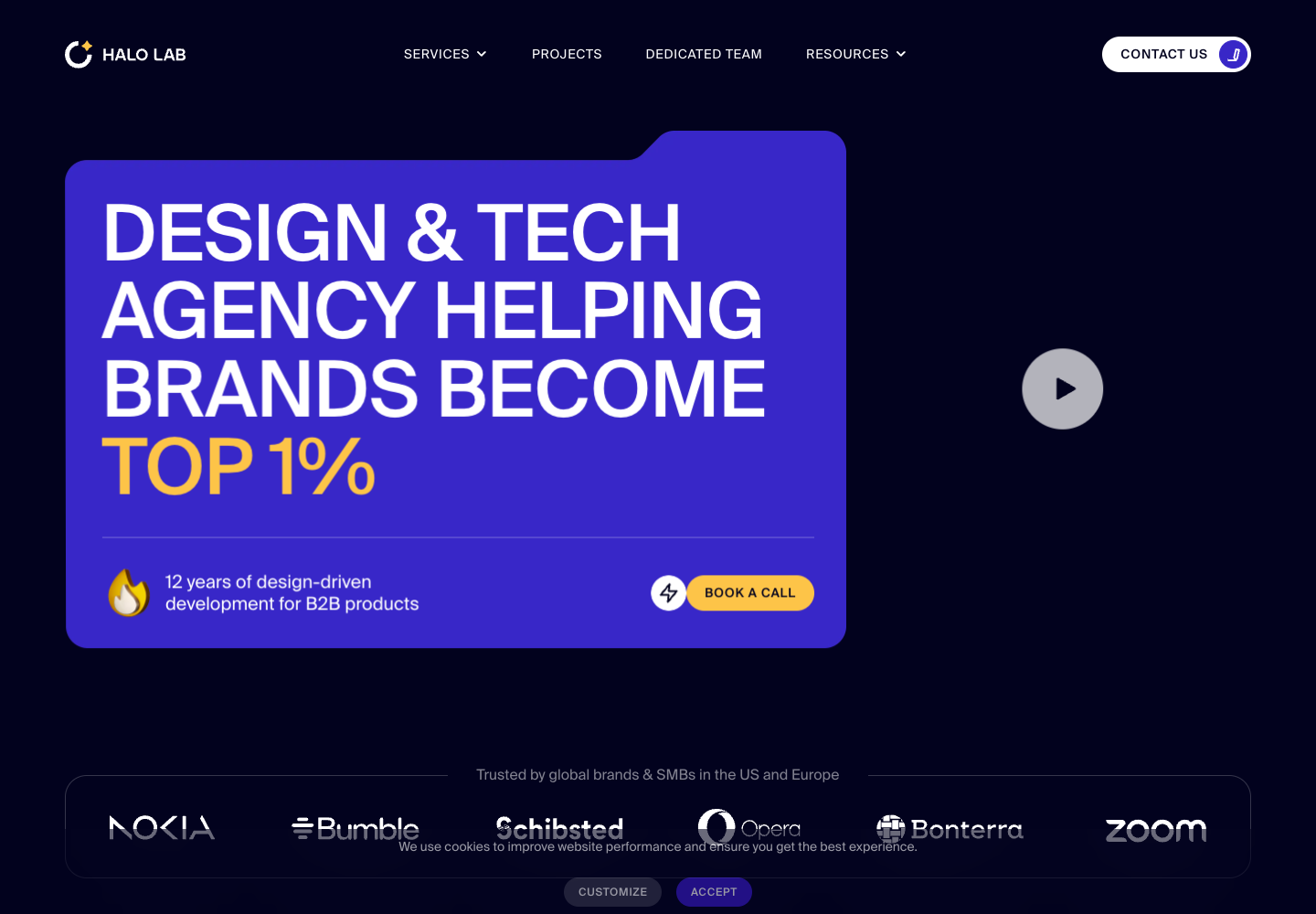
Best for: VC-backed startups that need coordinated execution across brand, UI, and implementation under one roof, especially when internal design resources are thin.
Halo Lab positions itself as a full-stack design and development partner for funded startups. The appeal is breadth: one team handling brand, product UI, and build workstreams simultaneously, which can simplify coordination for founders who do not want to manage multiple agency relationships at once.
Strength | Consideration |
|---|
Broad execution across brand, product, and dev | Less opinionated on brand strategy and narrative |
Fast execution speed | Depth of strategic thinking varies by project |
Single-partner coordination | May not be the right fit for complex identity repositioning |
VC-startup experience | Limited public case evidence tying work to funding outcomes |
Where Halo Lab fits best:
Startups that need to ship across multiple design workstreams quickly
Teams with thin internal resources who want one coordinated external partner
Founders who have a clear brief and need execution more than strategy
Where to apply diligence: The core question is whether you need breadth or depth. If the primary challenge is a messy brand identity that needs to be rethought from the positioning level down, a studio with a stronger brand strategy practice will be more useful.
7. The Branx
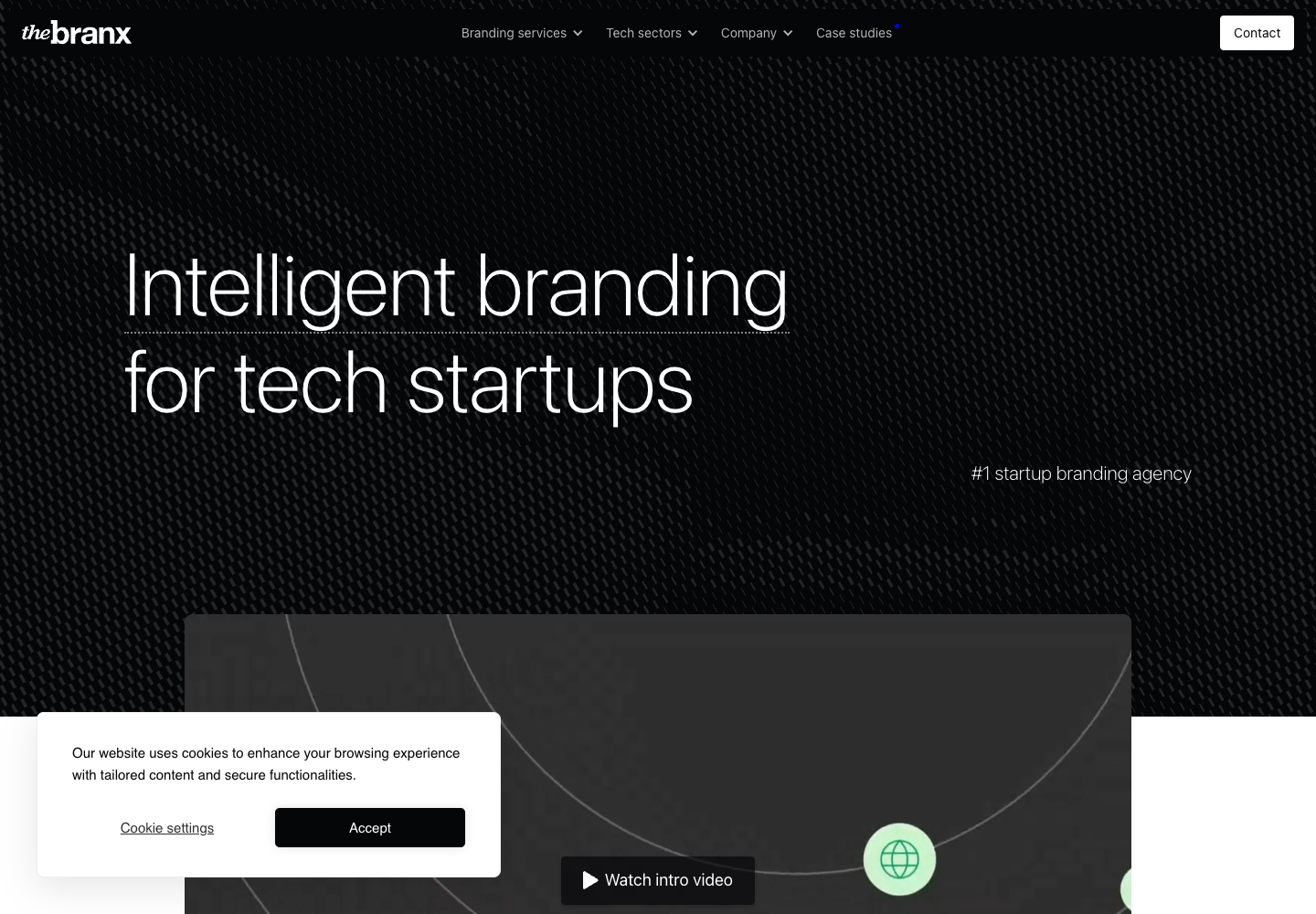
Best for: Pre-seed through early Series A founders who need startup-focused branding with more budget sensitivity than premium studios, and a clear story without overbuying scope.
The Branx has positioned itself specifically around startup branding. They have worked with over 70 startups since launching, according to third-party roundup data, and their Clutch rating sits at approximately 4.9 stars. The startup-native focus is genuine: they understand the pace, the constraints, and the kind of iterative process that early-stage companies need.
Pricing is more accessible than premium boutiques. Third-party sources cite project ranges from roughly $3,000 to $20,000 depending on scope, with many engagements starting around $10,000. That makes The Branx a realistic option for founders who need a sharper brand presentation but are not yet at the budget level where a $40,000 to $100,000 engagement makes sense.
Where to apply diligence: Accessible pricing at startup pace usually means the strategic layer is lighter. For founders at the earlier end of Series A whose core need is a cleaner visual presentation and a sharper story, The Branx delivers real value. For founders who need a full identity system, complex narrative distillation, or product design alongside brand work, the scope may not be sufficient.
How to Choose the Right Agency for Your Startup
Start by identifying what you actually need. Most founders think they need a rebrand. What they often need is a clearer story, a more consistent product, or a site that reflects the company they have become rather than the company they were when they launched. The agency choice follows from that diagnosis, not from portfolio aesthetics.
Eight questions to answer before you shortlist:
Do we know what we stand for? If the answer is no, you need a studio with strong brand strategy capabilities, not just execution.
Is our main problem visual strategy, brand identity, product design, website, or all three? Different studios have different strengths. Know which problem is primary.
Who will actually do the work? Ask directly. If the answer involves account managers, junior designers, or outsourced resources, factor that in.
Can we find their clients? Search for the companies in their portfolio. If they are real, funded, and publicly operating, that is a good sign.
Does their portfolio show range? If every project looks like it came from the same template, your brand will too.
Can they work at our pace? Ask how they handle iteration, pivots, and feedback loops. Rigid phase-gate processes do not fit Series A speed.
What is actually in scope? Get a written scope before comparing prices. Two $30K engagements are often very different things.
What happens after delivery? A good studio builds a system your team can extend. Ask what that looks like in practice.
Use these questions as a scorecard. The agency that answers all eight clearly and specifically is the one worth a longer conversation.
FAQ: Design Agencies for Series A Startups
What should a Series A startup budget for branding and design in 2026?
The realistic range for a brand identity engagement at Series A is $15,000 to $40,000 for identity work alone, according to 2026 benchmark data. Broader engagements covering identity, product design, website, and design systems typically run $60,000 to $100,000 or more depending on scope and studio.
When should a startup rebrand after raising Series A?
The best time is before the next major external moment: a product launch, a sales push into a new market, or the beginning of a Series B fundraise. Most founders wait too long. A focused identity engagement can turn around in two to four weeks for a well-scoped project.
Do we need one agency for brand, website, and product design, or separate specialists?
It depends on the studio's actual capabilities and your internal team's ability to coordinate. If you find a studio that can do all three at the level you need, that is simpler. If you cannot, it is better to use the right specialist for each workstream.
How do investors judge startup branding during fundraising?
According to a First Round Capital survey, 68% of investors say presentation quality influences their perception of a startup's professionalism. Beyond aesthetics, investors look for consistency across touchpoints, design that reinforces the company's narrative, and uniqueness that signals conviction rather than a templated approach.
If you are approaching Series A and the brand has not kept up with the product start here.