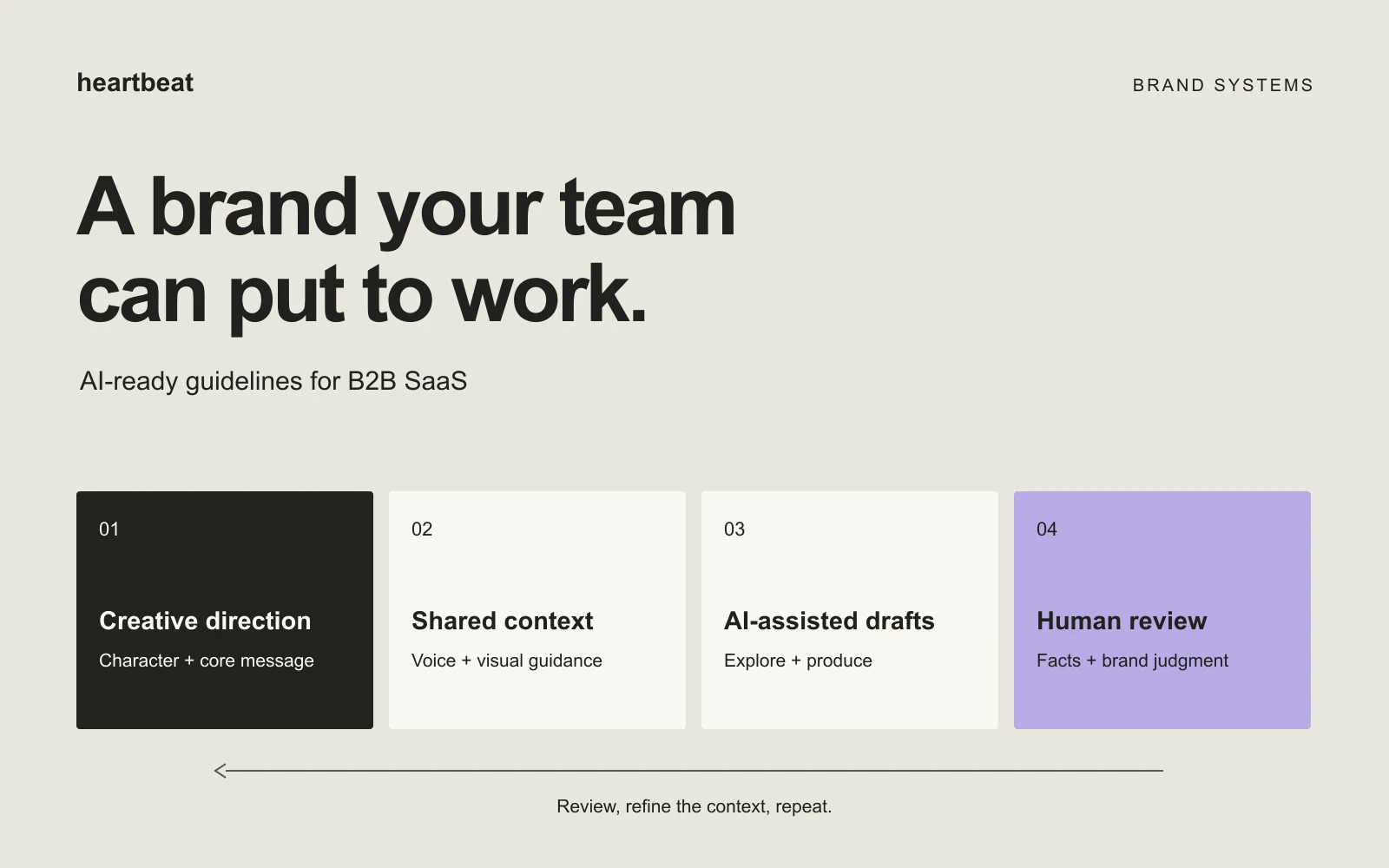
An AI-ready brand system is a structured set of materials that helps AI writing and image tools produce on-brand output: positioning documents, tone examples, visual generation guidance, and an evaluation rubric. Unlike a traditional guidelines PDF, which was designed for human designers to read and interpret, these materials are written to be used as direct context for AI tools. The difference matters because the quality of AI output depends heavily on the completeness, specificity, and accessibility of the context it receives.
To make this concrete: imagine a SaaS marketing team using a language model to draft a LinkedIn post. Without structured context, the model draws on general patterns and produces fluent, generic copy that could belong to any company. With a positioning document that includes the company's core message, approved claim formats, and prohibited phrases, the same model has more specific guidance to work from. The output still needs human review, and reviewers check every factual claim regardless of how confident the draft sounds, but the starting point is closer to usable.
This article explains what an AI-ready brand system contains, where a conventional guidelines document falls short, and how to build the operational layer on top of your existing identity.
Where a Conventional Guidelines Document Falls Short
A traditional brand guidelines document is a reference artifact. It shows the logo clearance zone, approved color palette, typefaces, and tone adjectives. It was designed to be read by designers who would then apply judgment to each new piece of work.
AI tools can read a PDF and extract information from it. The practical problem is not the format. It is that a standard guidelines document may lack the specificity AI tools need to produce useful output: if it describes what the brand looks like rather than how to generate it, if it characterizes tone in adjectives rather than demonstrating it through examples, or if it provides no rubric for evaluating output, the gap between context and usable draft widens.
Three gaps that reduce output quality
Incomplete visual context. If a guidelines document shows approved colors and type combinations but does not describe the photographic mood, illustration style logic, or visual clichés the brand avoids, an AI image tool will fill in everything else from general patterns.
Tone described in adjectives, not examples. If the voice guidance stops at adjectives like "confident, clear, approachable" without demonstrating them through in-voice and out-of-voice examples, approved sentence structures, and prohibited phrases, a model defaults to whatever sounds most fluent in its training data.
No evaluation rubric. If a guidelines document describes what the brand should be but provides no criteria for evaluating whether a specific AI output meets that standard, every review becomes a subjective judgment call made by whoever happens to be looking.
The implication: structured context does not guarantee accurate or perfectly consistent output. AI tools still require human fact-checking and review. But richer, more specific context reduces the gap between a raw AI draft and something usable.
What an AI-Ready Brand System Contains
An AI-ready brand system is an operational layer built on top of your existing identity. It translates creative decisions into structured materials that AI tools can use as context. Four components make up a complete system.
1. Structured positioning and message hierarchy
This is the foundation everything else depends on. A structured positioning document for AI use goes beyond a tagline. It includes:
The company's core transformation: what problem it solves and for whom, in customer language rather than feature language
A message hierarchy: primary claim, supporting claims, proof points, and the approved sequence in which they appear
Audience-specific variants: the same core message expressed differently for different buyer roles
Approved claim formats: specific phrases reviewed for accuracy
Prohibited claims: things the company should not say because they are unverifiable or misrepresent the product
With this as context, a language model can draft copy that stays within the approved message space. Without it, the model fills in the gaps with plausible-sounding language that may not be accurate.
2. Tone and voice with operational examples
An effective voice document moves from adjectives to demonstrations.
| Element | What it contains |
|---|
| Tone in context | The same idea written in-voice and out-of-voice, side by side |
| Sentence structure | Preferred patterns, typical length, acceptable complexity |
| Prohibited phrases | Specific constructions to avoid, with alternatives |
| Approved openers | First-sentence patterns for different content types |
| Formality calibration | How the voice shifts: website headline vs. support email vs. LinkedIn post |
Tone in context
- What it contains
- The same idea written in-voice and out-of-voice, side by side
Sentence structure
- What it contains
- Preferred patterns, typical length, acceptable complexity
Prohibited phrases
- What it contains
- Specific constructions to avoid, with alternatives
Approved openers
- What it contains
- First-sentence patterns for different content types
Formality calibration
- What it contains
- How the voice shifts: website headline vs. support email vs. LinkedIn post
3. Visual generation guidance
For teams using AI image tools or branded generators, visual guidance needs to describe the brand's visual logic, not just show finished examples. This includes photographic direction (mood, lighting, composition, clichés to avoid), illustration style parameters, and a short checklist a non-designer can use to evaluate a generated image before publishing.
4. Evaluation rubric and governance
A rubric answers the question teams face every time they review AI-generated content: is this good enough to publish? A practical rubric specifies on-brand indicators, off-brand indicators, which content types require human review before publishing, and who handles edge cases.
Governance rules clarify ownership: who can update the brand context, who approves changes to approved claims, and how the system is maintained as the product evolves.
A Practical Example: Context In, Better Output Out
Here is a simplified illustration of what structured context changes in practice. The scenario is hypothetical; the mechanism is not.
Without brand context
Prompt: Write a LinkedIn post announcing our new analytics dashboard.
Output: "Excited to announce our new analytics dashboard! Get real-time insights, track your KPIs, and make data-driven decisions faster than ever. Try it today."
Fluent. Generic. Could belong to any SaaS product.
With a positioning document as context
The context includes: the company helps operations teams at mid-market manufacturers reduce unplanned downtime; the approved primary claim is "less downtime, not more dashboards"; prohibited phrases include "data-driven," "real-time insights," and "excited to announce."
Output: "A new dashboard view for manufacturing operations teams. Explore the update and see how it fits your team's workflow."
The reviewer's job is to check both facts and voice independently, not to accept accuracy because the tone sounds right. In this case, the known facts are: a new dashboard view exists, the audience is operations teams at manufacturers. No other product details were given as context, so none appear in the output. The voice and message direction are closer to usable; the reviewer confirms the facts before publishing.
A reusable context template
The following structure gives a language model enough to work with for most short-form brand copy. Fill in each field for your company; keep it under one page.
Company: [Name]
What we do: [One sentence in customer language, not feature language]
Who we serve: [Specific role or company type]
Core message: [Primary claim, as approved]
Tone: [2-3 adjectives + one example sentence that demonstrates them]
Approved phrases: [3-5 specific constructions that are on-brand]
Prohibited phrases: [3-5 specific constructions to avoid, with alternatives]
What we never claim: [Unverifiable or legally sensitive statements]
Review required for: [Content types that need human sign-off before publishing]
This is a starting point, not a complete system. A full positioning document, voice guide, and evaluation rubric will be more detailed. But even this template reduces the gap between a raw AI draft and something a human reviewer can work with efficiently.
Creative Foundation First, Tooling After
Building the operational layer before resolving the creative foundation is a reliable way to produce consistent output that consistently misses the mark. If a team's positioning is unclear or internally contested, encoding it into AI context scales the ambiguity rather than resolving it.
The sequence that works:
Resolve the creative foundation. Understand the product, the customer, and the market transformation the company is bringing. Establish a character and a core message that the team agrees on. This requires human judgment and cannot be shortcut with tooling.
Prove it on one surface. Test the positioning and voice on the most commercially important surface before encoding it into templates. This surfaces inconsistencies while they are still easy to fix.
Encode the system. Translate the resolved foundation into structured materials: positioning documents, voice examples with in-voice and out-of-voice demonstrations, visual generation guidance, and an evaluation rubric.
Define governance. Establish who owns the brand context, how it gets updated, and what requires human review before publishing.
Scale. With the system in place, teams can use AI tools for content production while staying within the approved brand space. The designer's role shifts from producing every asset to maintaining the system and reviewing edge cases.
The creative work is not the "soft" part that can be deferred in favor of the more technical configuration work. It is what determines whether the operational layer is worth building.
What requires human judgment throughout
AI tools can participate in exploration and execution. They can generate drafts, propose variations, and surface options at speed. But specific decisions remain with people: establishing the company's character and core message, determining which claims are accurate and which are aspirational, evaluating output in contexts the rubric did not anticipate, and updating the system when the product or market changes.
A well-built brand system makes the boundary between AI-assisted work and human judgment explicit, so teams know when to trust a draft and when to escalate.
What This Looks Like in Practice
Two projects we have worked on illustrate different aspects of what an operational brand system looks like when delivered.
GovEagle: brand context prepared for AI tools
GovEagle is an AI platform for government contractors that connects teams across opportunity finding, proposal preparation, and contract delivery. The existing brand gave buyers a narrower impression of the platform than the product deserved.
We worked on positioning and messaging, visual identity, website design and development, illustrations, and sales collateral. As part of the engagement, we prepared Markdown files with brand context and guidance for AI tools, alongside a branded illustration generator. The GovEagle team could use these materials to create content and images with a shared direction, without requiring a designer for every asset.
This is a concrete example of an AI-ready deliverable: structured brand context, prepared in a format AI tools can use directly.
Caplena: a design system built to be extended
Caplena is a Swiss AI feedback analytics platform and ETH Zurich spinoff. We delivered an end-to-end redesign covering brand identity, product design, illustrations, stationery, website, and motion design.
The outcome we would highlight here is different: the Caplena team extends the system internally. The guidelines and design system were built to be used after the engagement ended, not archived. That extensibility is the standard any brand system should meet before an AI layer is added on top of it.
Where to Start
A practical starting point is an honest audit of what you currently have. Pull your existing brand guidelines and read them from the perspective of someone who has never met your team. What can they use to produce on-brand content? What would they have to guess?
Then work through these questions:
If five people on your team each wrote a LinkedIn post about your product today, would the core message be consistent?
Does your guidelines document contain approved claim formats and prohibited phrases, or only tone adjectives?
Could a new team member use your positioning document to write accurate copy without asking for clarification?
If someone used an AI image tool for a campaign, would they know what to generate and what to avoid?
When reviewing AI-generated content, what criteria does your team use beyond personal judgment?
The answers will surface where the gaps are. If the positioning foundation is solid, the operational layer can be built on top of it. If the positioning is unclear or contested internally, that is the right starting point, before any AI context is written.
Brand systems require ongoing maintenance. Approved claims change as products evolve. New content types emerge. The governance structure you establish at the start determines how manageable that maintenance is over time.
If you are working through this and want to talk through what the right starting point is for your company, we are available for a conversation.